Review: policies promoting a sustainable recovery

The first set of recommendations from economists in response to the COVID-19 crisis saw a broad consensus that can be summarized as:

  • Act fast,
  • Do whatever it takes,
  • ‘Flatten the recession curve’ [Baldwin and di Mauro, 2020].

In the midst of a very broad range of possible outcomes, the debate on how to foster a sustainable recovery has been striking for the prominence of policies with the double merit of boosting growth and the economy’s capacity to grow whilst reducing CO2 emissions. The below summarises the main themes with a slight bias towards the UK, but with broad application.    

The impact of the crisis

All crises leave scars:

  • Balance sheets: the accumulation of debt by governments, businesses and households is inevitable; the presumption is that in contrast to the post-2008 crisis, governments will seek to grow out of the current / coming debt accumulation or perhaps find new approaches to taxation rather than repeat the post-2008 spending restraints that tended to exacerbate inequalities [Haldane in Stern et al, Strategy…, 2020];
  • Behavioural: absent strong direction from the public sector, the expectation is of a highly conservative private sector response to the shock (increased desired savings, etc) [Haldane, ibid];
  • Changed social contract [Chater and Delaney in Chater et al, 2020] with increased concern over how people are disconnected from society [Larden in Chater et al, 2020];
  • Complex systems that have been ‘jumbled up’ are unlikely to return to their previous state [Hahn in Chater et al, 2020].

In no way was this a typical economic downturn:

  • Deliberate inducement of the recession for public health purposes [Tenrayo in Velasco et al, 2020];
  • Simultaneous implementation of programmes to stabilize businesses through loans, cushion income losses, prevent normal creditor reactions to credit payment interruptions and preserve worker-firm matches [Blundell, 2020] as well as massive monetary stimulus to underpin liquidity;
  • Very little moral hazard [Tirole, 2020]  

COVID-19 likely to exacerbate existing inequalities and create new ones:

  • Inequalities were evident in many economies across, for example, income, education, race, sex [focusing on the UK as an example, Blundell, ibid]. In the US, as a less frequently observed example, suicide risk since 1995 has increased ‘almost exclusively’ amongst those without a college degree [Deaton, 2020];
  • Healthcare inequalities and social insurance limitations act as a fault-line in the US [Stiglitz, 2020];
  • Access to education has been highly (undesirably) stratified during the lockdown, with likely long-lasting impacts [Blundell, ibid];
  • In developing countries, there is a clear risk of undoing a decade of progress in taking people out of poverty and a possibility that the lockdowns have as severe an effect on health as the virus itself [Khan in Velasco et al, 2020].

Increased incentives to substitute Capital for Labour:

  • The digital investment catalyst ‘just happened,’ reflecting the inability to run businesses in its absence [Haldane, ibid];
  • Reassessment of the infrastructure and management costs needed to support office-based and home-working as well as the expectation of increased illness [Haldane, ibid];
  • Expect a significantly negative impact on social mobility, with a high priority for policy to prevent new rounds of long-term unemployment [Machin in Stern et al, Policy… 2020];
  • Aggressively subsidise labour demand as an immediate response [Velasco in Stern et al, Policy… 2020].

Policy constraints:

Expectations for policy constraints in the period after the immediate recovery:

  • High public debt: whilst growing out of it sounds great, what is the policy mix that creates success where previously there has been none? In response to high debt, governments either raise taxes above spending or depress interest rates below growth rates [Reis in Velasco et al, 2020];
  • Poor productivity: possible contributions through monopoly power (via under-investment) and the misallocation of investment (abundantly clearly through CO2 emissions, perhaps also zombie companies sustained by ultra-low interest rates) [Reis, ibid]
  • Tirole [ibid] proposes five scenarios for the policy response to high debt:
    • Run primary surplus;
    • Restructure debt;
    • Exceptional wealth taxes, either on households or (with high risk in the euro area) banks;
    • Debt monetisation, with the risk of raising inequality through the impact of inflation on those without employment income or with only nominal assets as savings;
    • Collaborative stimulus measures that

Policy Themes

Resilience

  • Increasing resilience has to be a core policy focus [King, 2020];
  • Address widespread policy myopia likely requiring increased investment at the expense of consumption [Tirole, ibid]
  • Investment in social and institutional capital to deliver functional government [Zenghelis in Stern, Strategy… 2020] but not in a traditional centralized system [Rajan 2020; Coyle in Stern, Policy…, 2020];
  • Public goods that are privatised become potential sources of fragility [Deaton ibid, Stiglitz ibid];
  • Yet, the private sector can have a core role in enhancing resilience and public sector capacities [Romer, 2020] as witnessed by the contribution of private laboratories to greatly expand Germany’s testing capacity;
  • ‘Reshoring’ does not equate to resilience [Tirole, ibid]
  • Strengthen labour markets to cut short negative feedback loops:
    • social insurance,
    • skills agenda for green transition;
    • human capital tax credits;
    • improve demand/supply matching information/coordination in local labour markets [Blundell ibid, Machin ibid];
  • Simply rebuilding businesses with pre-crisis exposure to climate change would be a catastrophic failure to improve resilience – see below.

‘Build back better’

  • Stern et al’s motivation [Stern, Strategy…, 2020] for focusing policy efforts comes from an assessment of woeful productivity, inadequate investment, the experience of austerity as a catalyst / amplifier for increased inequality, regional inequalities, under-investment in natural and social capital as well as an emphasis on the labour skills required for the green transition;
  • Survey responses compiled by Hepburn et al emphasise the desirability of five types of policy:
    • Clean infrastructure;
    • Building efficiency retrofits;
    • Natural capital;
    • Education and training;
    • Clean R&D.
  • For a discussion of building energy retrofits specifically and system complexity from an engineering perspective, more generally, see Mayfield 2020.

Accelerate investment required to render a sustainable recovery

  • Directly targets the inadequacy of investment in the last cycle, provides an immediate source of demand stimulus and employment whilst also providing a CO2-reducing supply boost if correctly targeted [Zhengelis, ibid];       
  • IMF and OECD estimate investment multipliers of 2.5-3x the size of the initial investment [Llewellyn in Stern et al, Strategy…, 2020];
  • Infrastructure investment has the capacity to crowd-in private sector investment through network effects and concentrate private sector expectations around climate change objectives in ways that other policies cannot [Grubb 2014, Zhengelis ibid];
  • It can be combined with revenue-raising / redistributing policies that reinforce the shift to cut carbon emissions [Burke et al, 2020];
  • It pushes on an open door in that the cost of capital has already shifted dramatically against carbon-intense activities.

Bibliography

P Aghion, C Hepburn, A Teytelboym, D Zenghelis, Path dependence and the economics of climate change, The New Climate Economy, 2020

R Baldwin, B Weder di Mauro et al, Mitigating the COVID Economics Crisis, 2020

R Blundell, Inequality and the COVID-19 crisis, Royal Economic Society webinar, 2020 

J Burke, S Fankhauser, A Bowen, Pricing carbon during the economic recovery from the COVID-19 pandemic, Grantham Research Institute Policy Brief, 2020

N Chater et al, Behavioural science in the context of great uncertainty, LSE webinar, 2020

A Deaton, Inequality and the COVID-19 crisis, Royal Economic Society webinar, 2020

H Doukas et al, Convergence between technological progress and sustainability is not that obvious, 2020 

C Goodhart, M Pradhan, Future imperfect after Coronavirus, 2020

M Grubb, Planetary Economics, Routledge, 2014

C Hepburn et al: Will COVID-19 fiscal response packages accelerate or retard progress on climate change?, 2020

P Watkins et al, COVID-19 and de-globalisation, LSE webinar, 2020

M King, Radical Uncertainty, SPE podcast, 2020

M Mayfield, Climate Change: Hoping for the best, planning for the worst, webinar, 2020

P Romer, Conditional Optimism

P Romer, Roadmap to responsibly reopen America, 2020

R Rajan, How to save global capitalism from itself, Foreign Policy, 2020

J Stiglitz, Four priorities for pandemic relief efforts, Roosevelt Institute, 2020

N Stern et al, Strategy and investment for a strong and sustainable recovery, Royal Economic Society webinar, 2020

N Stern et al, Policy for a strong and sustainable recovery, Royal Economic Society webinar, 2020

N Stern et al, Finance for a strong and sustainable recovery, Royal Economic Society webinar, 2020

J Tirole, The short, medium and long run economic impact of the crisis, Royal Economic Society webinar, 2020

A Velasco et al, COVID-19: The economic policy response, LSE webinar, 2020

Real forward exchange rates: investable valuation metrics

We consider the utility of the real forward exchange rate as an investable valuation metric, focusing on a number of EM Latin American countries to demonstrate the application of the concept for a USD or GBP-based investor. We show why we think the metric is useful both as a gauge of all-in risk premiums, a guide to the timing of investments and as a way to consider the appropriate risk bucket for the underlying assets.

The real exchange rate adjusts for changes in the general level of prices between countries, thereby providing a tractable benchmark for currency pairs affected by a persistent imbalance in the level of inflation. In the same way that a forward exchange rate discounts interest differentials between countries over a certain period of time, a real forward exchange rate can be constructed using the combination of the real exchange rate and real interest rate differentials.

The chart below shows the concept for USDBRL. We rebase the spot real exchange rate to equal 100 in 2004, generating a real forward exchange rate based on the compounded real interest rate differentials between Brazil and the US.

USDBRL: real exchange rate, real yield spreads and real forward exchange rate; Source: Bloomberg

At any point in time, what the measure captures is the ability for a holder of an inflation-linked bond in the US to sell the bond, exchange the dollar proceeds for Brazilian real and to use those proceeds to buy a Brazilian inflation-linked bond. The investor is compensated for increases in Brazilian CPI for the remaining lifetime of the bond, providing something of a cushion against declines in the nominal exchange rate, with the higher level of real yields compensating for a combination of higher default risk, greater return correlation to risky assets in economic downturns as well as the risk of a depreciation of the real exchange rate before the principal is repaid.

Although this is the purest application of the concept, regulatory constraints on many holders of inflation-linked bonds reduce the number of investors who would consider this type of transaction in practice. We therefore complement it with a simpler variant in which we show the combination of the real exchange rate and the real yield of the higher-yielding market. The resulting hybrid measure shows the protection for a cash investor in the lower-yielding currency assuming that their investment alternative would be to hold a zero real-yield asset in their domestic currency. In practice, this might either be too low or too high, depending on the domestic monetary policy regime in place, but the approach has the merit of isolating the contribution of the higher yielding asset to the investment decision. We label this hybrid measure ‘cash investor’s protection’ in the charts below.

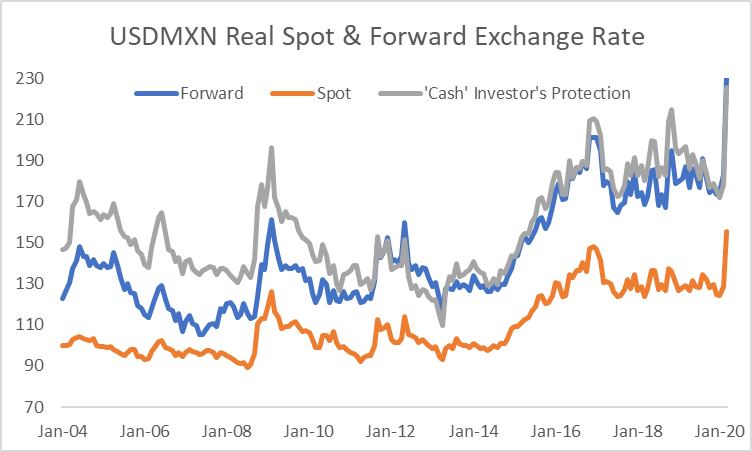
In the chart below, we show the application of the two concepts to USDMXN. The impact of the US monetary policy regime on the difference between the real forward exchange rate and the ‘cash investor’s protection’ is readily apparent: prior to the 2008 crisis when US real interest rates were consistently positive, the assumption of zero US real interest rates in calculation of the ‘cash investor’s protection’ has the effect of boosting that measure well above the forward. By contrast, post-crisis, with US real interest rates close to zero most of the time, the difference between the two metrics has typically become relatively modest.

USDMXN real exchange rate and two alternative forward measures: see text for details; Source: Bloomberg

In the UK, because the impact of regulation on investor behaviour has become increasingly influential in depressing inflation-linked yields relative to other countries, the difference between the two measures has, by contrast, become increasingly substantial.

GBPMXN: real exchange rate and two alternative forward measures – see text for details; Source: Bloomberg

The chart above is also notable for the fact that the GBPMXN real exchange rate has exhibited far greater stability than the USDMXN real exchange rate.

We consider two primary drivers of the real exchange rate: the first is productivity, given the expectation that low income countries will experience faster domestic services inflation as their productivity rises and income levels converge with higher income countries; the second is current and expected terms of trade, particularly for countries with high exposure to commodities.

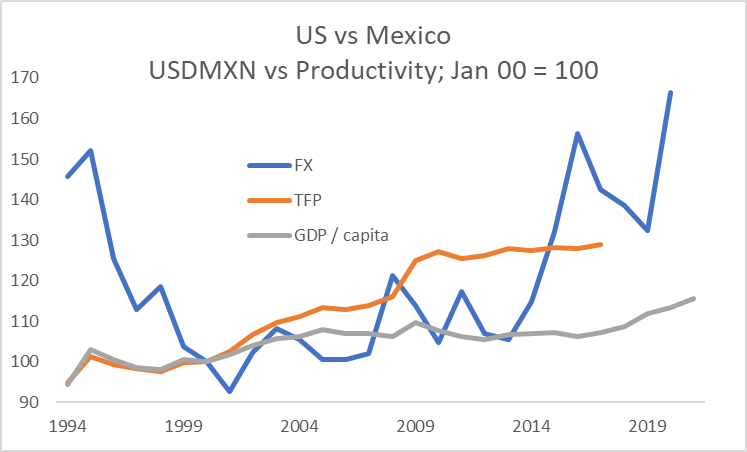
The chart below compares the USDMXN real exchange rate with two measures of productivity: the first is based on Total Factor Productivity growth differentials as reported in the Penn World Tables while the second shows changes in GDP per capita at PPP exchange rates, as reported by the IMF.

US vs Mexico: real exchange rate and productivity measures; Sources: Bloomberg, Penn World Tables, IMF

Depending on the metric used, over the period since 2000, the US has seen an improvement of productivity versus Mexico of 15-30%. As of the end of April 2020, the USDMXN real exchange rate had appreciated by just over 65% since 2000. The extent of the peso’s depreciation likely reflects some combination of market judgment that sustainedly lower oil prices may require a weaker Mexican real exchange rate relative to its historic level as well as the discount required on all riskier assets during a period of extreme uncertainty over activity and income levels.

We show two ways of evaluating performance.

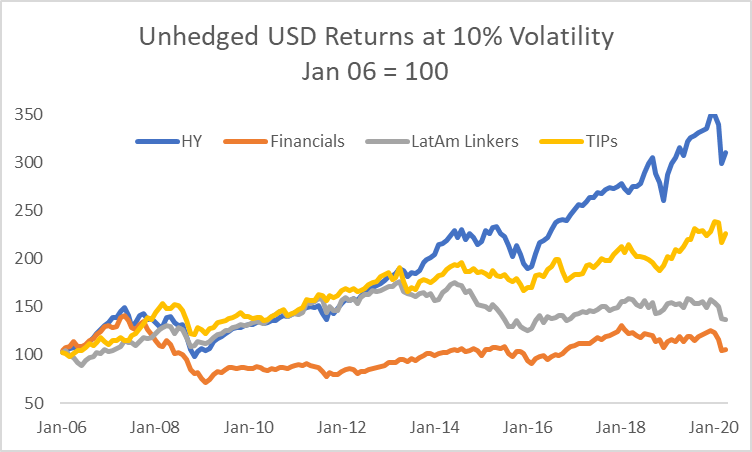
For the first, we construct an equally-weighted index based on Mexican, Brazilian and Chilean inflation-linked bonds, using the returns from the Barclays indices. Considering all the assets at 10% volatility, we then compare the returns with US TIPS, US High Yield credit and the MSCI World financials index, all expressed in unhedged USD terms.

LatAm inflation-linked bond unhedged returns in USD compared with selected assets; Source: Bloomberg

We can make three clear observations from the returns history:

  • All of the assets saw a substantial repricing during the 2008 crisis; in contrast to the others, global financials struggled to recover as capital needs and the regulatory costs associated with the business increased (less apparent from the chart but nonetheless the case is that LatAm linkers have delivered a similar return profile at 10% volatility to global financials since 2016);
  • Until 2013-2014, the return profile for LatAm inflation-linked bonds in USD terms was readily comparable with US High Yield and TIPS; the subsequent bifurcation likely reflected a combination of (I) the end of China’s commodity binge, (II) the oil market collapse in 2015; (III) Brazil’s financial crisis, and (IV) the upward shift in USD real rates and the dollar itself as the Fed moved away from emergency settings for interest rates and US fiscal policy become highly stimulatory under President Trump;
  • Even allowing for the occasionally large drawdowns, the returns from leveraged US credit have been competitive with almost all other major asset classes through the period.

Instead of constant exposure to the asset class, we now consider the merits of using the forward real exchange rate as a valuation indicator. In the charts below, we show two different investment cases for a USD-based and a GBP-based investor:

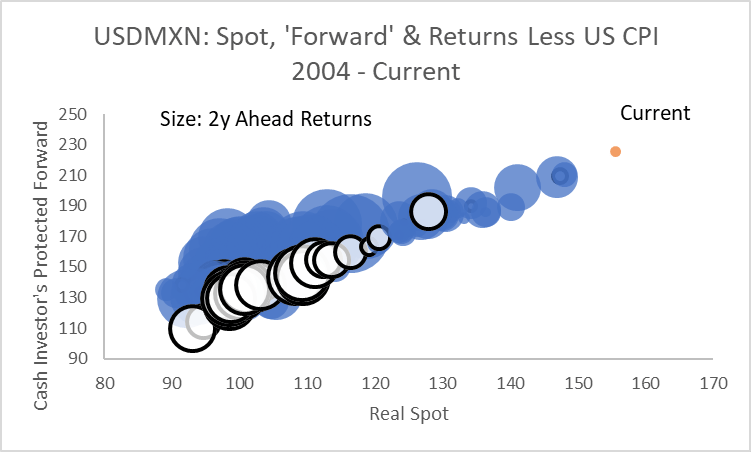
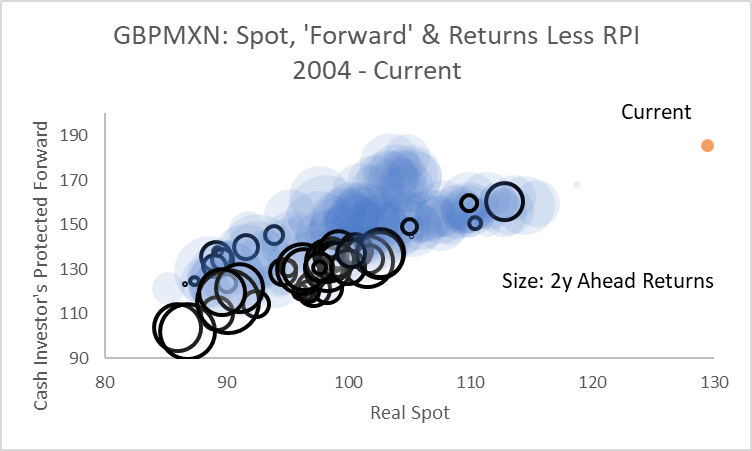
  • In the first case, we show unhedged Mexican inflation-linked bond returns less US or UK CPI relative to the real spot exchange rate and the ‘cash investor’s protection’ rate as an indication of whether Mexican inflation-linked bonds delivered a positive return in real USD or GBP terms over the subsequent two year period (we selected two years in all cases as an indicative period for mean-reversion of the real exchange rate and reduction in risk premiums through the cycle, making no attempt to optimise the holding period);
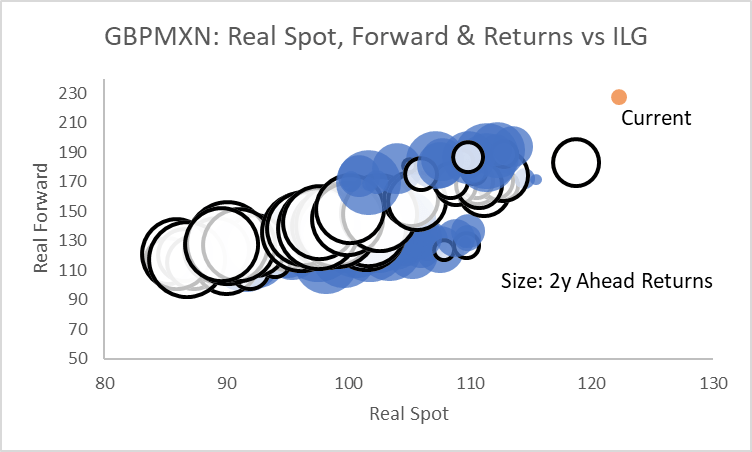
  • In the second case, using the real spot and forward exchange rates, we consider the more challenging hurdle of whether Mexican inflation-linked bonds outperformed domestic inflation-linked bonds over the subsequent two year period.

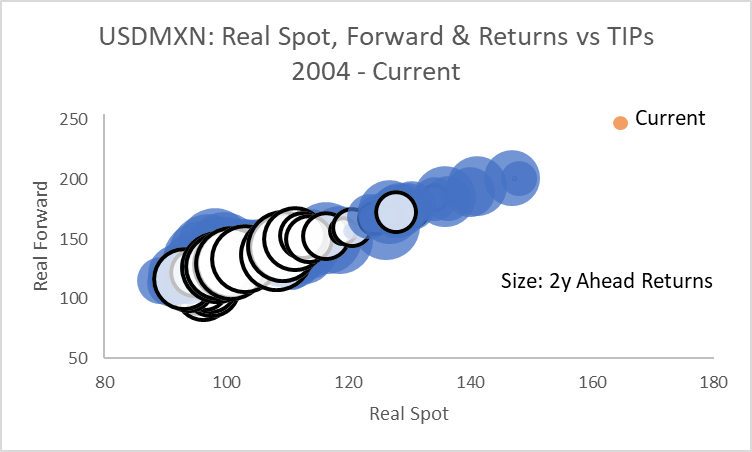
The two charts below show the case for a US-based investor. The blue bubbles indicative a positive return over US CPI for a USD-based investor, the white bubbles a negative return. Given a two year investment period, the clear indication from the chart is that the combination of the real spot and forward rate helps to identify the conditions under which positive returns in real USD terms are more likely to be delivered. The ‘Current’ point in each of the remaining charts refers to end-April 2020.

Unhedged USD returns for Mexican inflation-linked bonds; see text for details; Source: Bloomberg

By contrast, it is less apparent whether the construct is useful in identifying whether Mexican inflation-linked bonds will outperform TIPS in unhedged USD terms.

Return comparison: Mexican inflation linked bonds less TIPS; see text for details; Source: Bloomberg

These conclusions are reinforced when extending the analysis for a GBP-based investor.

Because the GBPMXN real exchange rate has been largely stable, the combination of the real spot and ‘cash investor’s protection’ rate have helped identify the conditions under which Mexican inflation-linked bonds are likely to deliver a positive return in real GBP terms over the subsequent two years.

Unhedged GBP returns for Mexican inflation-linked bonds; see text for details; Source: Bloomberg

However, over the period considered, it has almost always been a losing proposition to sell inflation-linked gilts relative to Mexican inflation-linked bonds, regardless of the starting-point for the real exchange rate.

This analysis helps draw out a number of different components of the investment decision for EM inflation-linked bonds:

  • EM inflation-linked bonds can deliver competitive returns for foreign investors;
  • However, for many G10 investors, they are best considered as part of the risky asset bucket – they cannot compete with long duration domestic bonds in an environment of deteriorating growth;
  • Similar to risky assets overall, a dynamic approach is best in determining the appropriate level of exposure through the cycle;
  • Analysis of the real exchange rate and appropriately-defined forwards has historically helped define the conditions under which these assets are most likely to perform;
  • Nonetheless, this does not do away with idiosyncratic policy decisions or risks from sudden institutional changes;
  • Looking forward, an investor’s judgment on the drivers of the real exchange rate and the outlook for an individual country’s creditworthiness can be used to help determine whether the compensation for risk offered by current entry points are sufficiently attractive or not.

The commentary contained in the above article does not constitute an offer or a solicitation, or a recommendation to implement or liquidate an investment or to carry out any other transaction. It should not be used as a basis for any investment decision or other decision. Any investment decision should be based on appropriate professional advice specific to your needs.

April returns and fundamentals

A brief annotation of the bifurcation between April’s market recovery and the underlying deterioration in fundamental conditions, summarised in six charts.

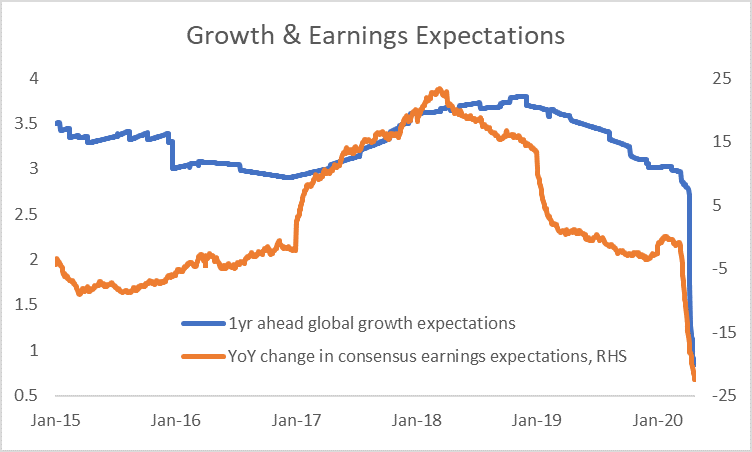
The underlying hit to growth expectations continued to build as the first post-lockdown data were released.

Consensus forecasts: 1y ahead global GDP growth and corporate earnings; Source: Bloomberg

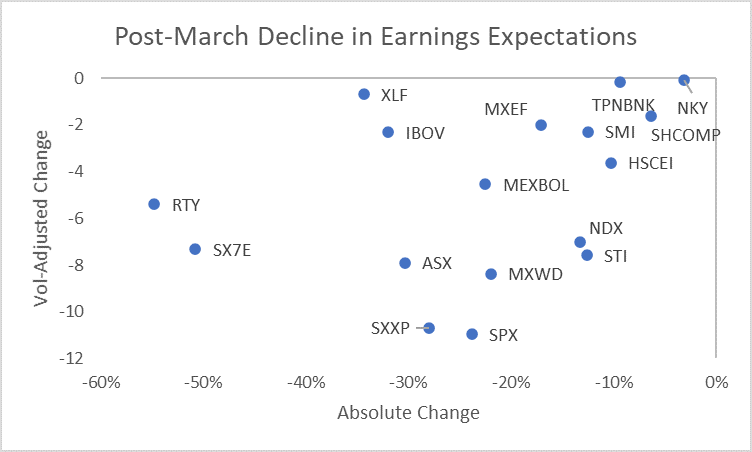
Since the beginning of March, the change in earnings expectations has been particularly severe for US cyclicals and European banks. Adjusted for the longer term volatility of expectations, the change at the broad index level in the US and Europe has been greatest.

Change in 1y ahead earnings estimates since March 1 2020 in absolute terms and adjusted for
post-2005 monthly volatility; Source: Bloomberg

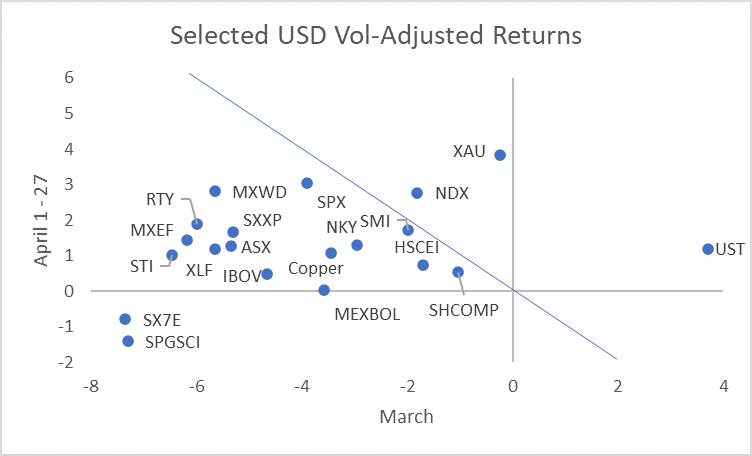
The market traded liquidity in preference to fundamentals in April. Looking at performance across March and April, the clearest beneficiaries from central bank liquidity were Treasuries, long duration equities (last cycle’s winners) and gold. Commodities and European banks failed to benefit much if at all.

Unhedged USD returns adjusted for 2018-2019 volatility; Source: Bloomberg

The effects of the central bank liquidity injections and asset purchases on the demand for protection against further asset market shocks was evident in the large-scale retracement of the earlier surge in implied volatility. The chart shows the cumulative Z-score based on data since 2001.

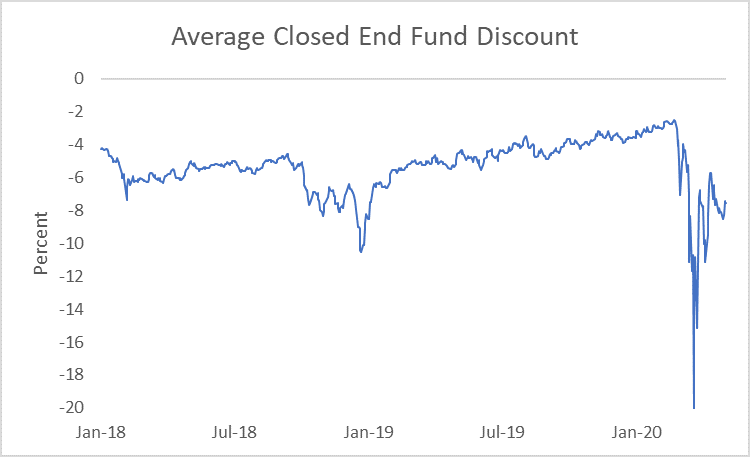
Other measures of liquidity risk in many cases improved further. Our measure of the closed end fund discount has not fully recovered from its March collapse, but has returned to levels that suggest much greater confidence in the pricing of assets and the ability to generate cash from less liquid holdings if required.

Average Closed End Fund Discount; see text link for details of construction; Source: Bloomberg

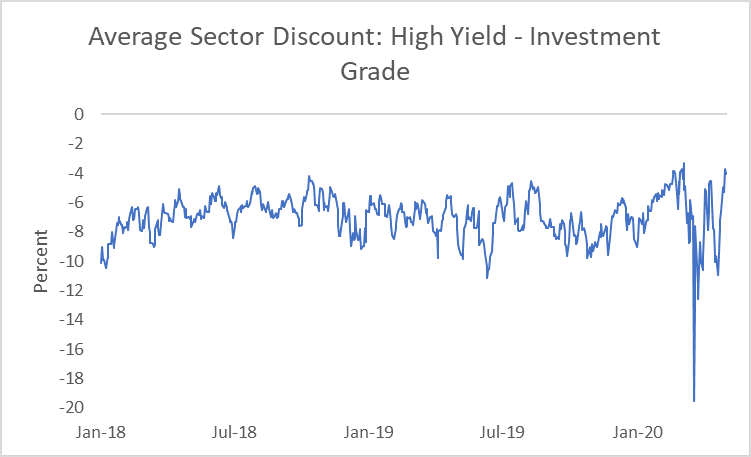
The effects of the Federal Reserve’s interventions were particularly notable in the US High Yield market to the extent that the discount for funds in that sector relative to Investment Grade funds is now towards the tightest it has traded at since 2015.

Average sector discount for High Yield less Investment Grade closed end funds; see link in text for
construction details; Source: Bloomberg