Connecting China’s Twin Sources of Leverage

Coming hot on the heels of the ECB’s climate change stress tests, Evergrande’s threatened default and possible debt restructuring expose some of the high-level challenges that may arise when economic policy seeks to counter the effects of unbridled expansion on environmental degradation.

“Where on earth are you getting that from?” you might well ask.

First, let’s be clear that Chinese policy concern over excessive debt accumulation long pre-dates the country’s recent decision to target net zero emissions. Entirely separate rationales can be identified for addressing the two problems; in particular, Kenneth Rogoff and Yuanchen Yang have recently exposed the stretched valuations in the Chinese housing sector based purely on conventional indicators.

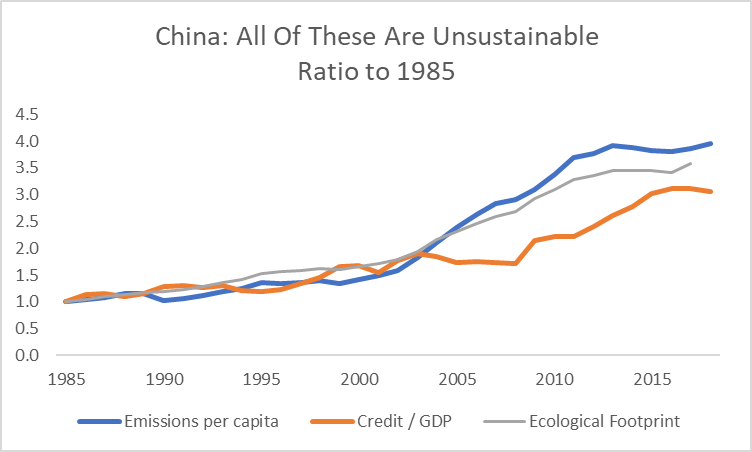
Second, China is far from unique in the combination of increased indebtedness and an unsustainable ecological footprint. What makes it particularly striking is the rapidity and extent with which the two have developed. For example, Chinese nonfinancial corporate debt/GDP almost doubled from an already elevated 110% of GDP in the decade after 2007. Periods of accelerated debt accumulation are often associated with credit being extended further and faster than systems of governance, regulation or even market evaluation can keep up, increasing the chances of debt stress later.

Despite these caveats, the reason for linking Evergrande with the ECB’s stress tests is the dual sources of leverage that have developed in China’s economy over the last twenty years: rapid economic expansion required the financing of large capex increases and encouraged expectations of future growth to become embedded in credit provision while, at the same time, the growth itself overloaded the country’s environmental capacity to sustain it, as shown in Global Footprint Network’s measure of China’s net biocapacity.

Source: Global Footprint Network

In cases like this, where assets are initially valued and credit allocated on the basis that the environment is a free resource, the imposition of an environmental constraint to economic activity through a policy target to reverse some form of environmental degradation may easily undermine the income and revenue expectations on which credit was provided. Moreover, the affected sectors need not be those most directly related to the policy constraint, but instead may be the ones where the build-up in debt was the largest and hence the likely sensitivity to changes in growth expectations highest.

Sources: Global Footprint Network; FRED: St Louis Federal Reserve database

The implication is clear: stress tests like those performed by the ECB that presume a VAT hike can be used to mimic the effects of a change in relative pricing may miss the (possibly more significant) system-wide nature of the economic adjustment to changes in economic and environmental constraints.

Viewed from a market practitioner’s perspective, conventional measures of financial leverage need to be enhanced to incorporate implicit environmental leverage, for example, through a measure of the beta of indebtedness at a corporate or sectoral level to emissions or environmental degradation. In practice, the most desirable measures of environmental degradation would be those most closely linked to that targeted for tighter environmental regulation.

To demonstrate with an example for China, we use an OECD report on sectoral debt accumulation and leverage, showing in the chart below a measure of the 5 year rolling sensitivity of leverage in selected sectors to increases in the level of environmental degradation.

Sources: OECD, Global Footprint Network

This exploration of implied financial leverage to the environment is very different from standard approaches to evaluating stranded asset risk which consider the scope for physical infrastructure to become unusable in the event that a binding carbon budget is imposed. Nonetheless, the underlying mechanism is the same – an environmental constraint is imposed which had not been factored into market expectations – and the applications to the assessment of market risk pricing are potentially significant as we enter a period where governmental environmental policy changes rapidly such that environmental constraints increase.

Review: policies promoting a sustainable recovery

The first set of recommendations from economists in response to the COVID-19 crisis saw a broad consensus that can be summarized as:

  • Act fast,
  • Do whatever it takes,
  • ‘Flatten the recession curve’ [Baldwin and di Mauro, 2020].

In the midst of a very broad range of possible outcomes, the debate on how to foster a sustainable recovery has been striking for the prominence of policies with the double merit of boosting growth and the economy’s capacity to grow whilst reducing CO2 emissions. The below summarises the main themes with a slight bias towards the UK, but with broad application.    

The impact of the crisis

All crises leave scars:

  • Balance sheets: the accumulation of debt by governments, businesses and households is inevitable; the presumption is that in contrast to the post-2008 crisis, governments will seek to grow out of the current / coming debt accumulation or perhaps find new approaches to taxation rather than repeat the post-2008 spending restraints that tended to exacerbate inequalities [Haldane in Stern et al, Strategy…, 2020];
  • Behavioural: absent strong direction from the public sector, the expectation is of a highly conservative private sector response to the shock (increased desired savings, etc) [Haldane, ibid];
  • Changed social contract [Chater and Delaney in Chater et al, 2020] with increased concern over how people are disconnected from society [Larden in Chater et al, 2020];
  • Complex systems that have been ‘jumbled up’ are unlikely to return to their previous state [Hahn in Chater et al, 2020].

In no way was this a typical economic downturn:

  • Deliberate inducement of the recession for public health purposes [Tenrayo in Velasco et al, 2020];
  • Simultaneous implementation of programmes to stabilize businesses through loans, cushion income losses, prevent normal creditor reactions to credit payment interruptions and preserve worker-firm matches [Blundell, 2020] as well as massive monetary stimulus to underpin liquidity;
  • Very little moral hazard [Tirole, 2020]  

COVID-19 likely to exacerbate existing inequalities and create new ones:

  • Inequalities were evident in many economies across, for example, income, education, race, sex [focusing on the UK as an example, Blundell, ibid]. In the US, as a less frequently observed example, suicide risk since 1995 has increased ‘almost exclusively’ amongst those without a college degree [Deaton, 2020];
  • Healthcare inequalities and social insurance limitations act as a fault-line in the US [Stiglitz, 2020];
  • Access to education has been highly (undesirably) stratified during the lockdown, with likely long-lasting impacts [Blundell, ibid];
  • In developing countries, there is a clear risk of undoing a decade of progress in taking people out of poverty and a possibility that the lockdowns have as severe an effect on health as the virus itself [Khan in Velasco et al, 2020].

Increased incentives to substitute Capital for Labour:

  • The digital investment catalyst ‘just happened,’ reflecting the inability to run businesses in its absence [Haldane, ibid];
  • Reassessment of the infrastructure and management costs needed to support office-based and home-working as well as the expectation of increased illness [Haldane, ibid];
  • Expect a significantly negative impact on social mobility, with a high priority for policy to prevent new rounds of long-term unemployment [Machin in Stern et al, Policy… 2020];
  • Aggressively subsidise labour demand as an immediate response [Velasco in Stern et al, Policy… 2020].

Policy constraints:

Expectations for policy constraints in the period after the immediate recovery:

  • High public debt: whilst growing out of it sounds great, what is the policy mix that creates success where previously there has been none? In response to high debt, governments either raise taxes above spending or depress interest rates below growth rates [Reis in Velasco et al, 2020];
  • Poor productivity: possible contributions through monopoly power (via under-investment) and the misallocation of investment (abundantly clearly through CO2 emissions, perhaps also zombie companies sustained by ultra-low interest rates) [Reis, ibid]
  • Tirole [ibid] proposes five scenarios for the policy response to high debt:
    • Run primary surplus;
    • Restructure debt;
    • Exceptional wealth taxes, either on households or (with high risk in the euro area) banks;
    • Debt monetisation, with the risk of raising inequality through the impact of inflation on those without employment income or with only nominal assets as savings;
    • Collaborative stimulus measures that

Policy Themes

Resilience

  • Increasing resilience has to be a core policy focus [King, 2020];
  • Address widespread policy myopia likely requiring increased investment at the expense of consumption [Tirole, ibid]
  • Investment in social and institutional capital to deliver functional government [Zenghelis in Stern, Strategy… 2020] but not in a traditional centralized system [Rajan 2020; Coyle in Stern, Policy…, 2020];
  • Public goods that are privatised become potential sources of fragility [Deaton ibid, Stiglitz ibid];
  • Yet, the private sector can have a core role in enhancing resilience and public sector capacities [Romer, 2020] as witnessed by the contribution of private laboratories to greatly expand Germany’s testing capacity;
  • ‘Reshoring’ does not equate to resilience [Tirole, ibid]
  • Strengthen labour markets to cut short negative feedback loops:
    • social insurance,
    • skills agenda for green transition;
    • human capital tax credits;
    • improve demand/supply matching information/coordination in local labour markets [Blundell ibid, Machin ibid];
  • Simply rebuilding businesses with pre-crisis exposure to climate change would be a catastrophic failure to improve resilience – see below.

‘Build back better’

  • Stern et al’s motivation [Stern, Strategy…, 2020] for focusing policy efforts comes from an assessment of woeful productivity, inadequate investment, the experience of austerity as a catalyst / amplifier for increased inequality, regional inequalities, under-investment in natural and social capital as well as an emphasis on the labour skills required for the green transition;
  • Survey responses compiled by Hepburn et al emphasise the desirability of five types of policy:
    • Clean infrastructure;
    • Building efficiency retrofits;
    • Natural capital;
    • Education and training;
    • Clean R&D.
  • For a discussion of building energy retrofits specifically and system complexity from an engineering perspective, more generally, see Mayfield 2020.

Accelerate investment required to render a sustainable recovery

  • Directly targets the inadequacy of investment in the last cycle, provides an immediate source of demand stimulus and employment whilst also providing a CO2-reducing supply boost if correctly targeted [Zhengelis, ibid];       
  • IMF and OECD estimate investment multipliers of 2.5-3x the size of the initial investment [Llewellyn in Stern et al, Strategy…, 2020];
  • Infrastructure investment has the capacity to crowd-in private sector investment through network effects and concentrate private sector expectations around climate change objectives in ways that other policies cannot [Grubb 2014, Zhengelis ibid];
  • It can be combined with revenue-raising / redistributing policies that reinforce the shift to cut carbon emissions [Burke et al, 2020];
  • It pushes on an open door in that the cost of capital has already shifted dramatically against carbon-intense activities.

Bibliography

P Aghion, C Hepburn, A Teytelboym, D Zenghelis, Path dependence and the economics of climate change, The New Climate Economy, 2020

R Baldwin, B Weder di Mauro et al, Mitigating the COVID Economics Crisis, 2020

R Blundell, Inequality and the COVID-19 crisis, Royal Economic Society webinar, 2020 

J Burke, S Fankhauser, A Bowen, Pricing carbon during the economic recovery from the COVID-19 pandemic, Grantham Research Institute Policy Brief, 2020

N Chater et al, Behavioural science in the context of great uncertainty, LSE webinar, 2020

A Deaton, Inequality and the COVID-19 crisis, Royal Economic Society webinar, 2020

H Doukas et al, Convergence between technological progress and sustainability is not that obvious, 2020 

C Goodhart, M Pradhan, Future imperfect after Coronavirus, 2020

M Grubb, Planetary Economics, Routledge, 2014

C Hepburn et al: Will COVID-19 fiscal response packages accelerate or retard progress on climate change?, 2020

P Watkins et al, COVID-19 and de-globalisation, LSE webinar, 2020

M King, Radical Uncertainty, SPE podcast, 2020

M Mayfield, Climate Change: Hoping for the best, planning for the worst, webinar, 2020

P Romer, Conditional Optimism

P Romer, Roadmap to responsibly reopen America, 2020

R Rajan, How to save global capitalism from itself, Foreign Policy, 2020

J Stiglitz, Four priorities for pandemic relief efforts, Roosevelt Institute, 2020

N Stern et al, Strategy and investment for a strong and sustainable recovery, Royal Economic Society webinar, 2020

N Stern et al, Policy for a strong and sustainable recovery, Royal Economic Society webinar, 2020

N Stern et al, Finance for a strong and sustainable recovery, Royal Economic Society webinar, 2020

J Tirole, The short, medium and long run economic impact of the crisis, Royal Economic Society webinar, 2020

A Velasco et al, COVID-19: The economic policy response, LSE webinar, 2020

Carbon in a macro portfolio

We explore the merits of different approaches to tracking carbon as a source of returns in a macro portfolio, concentrating on equity and FX markets.

Whereas the sector concentration of CO2 emissions makes it relatively easy to identify a high-level carbon factor in equities, FX is more challenging. We expose the ways in which construction of a carbon FX portfolio requires the integration of EM currencies and therefore careful risk management of non-carbon factors.

Our intention is to build towards a cross-asset expression of carbon in a macro portfolio. The approach we use is to identify summary financial exposures that an investor can monitor in expressing carbon as a theme and to define those exposures parsimoniously.

In starting, we summarise the building blocks we use in constructing a theme using asset returns:

  • Themes are designed to give constant exposure to a driver of asset returns;
  • They an be comprised of outright or long/short asset exposures;
  • They are constructed such that each exposure has 10% volatility to prevent returns from higher volatility assets dominating the signals from lower volatility assets;
  • The investor has constant exposure to a theme regardless of prior losses or profits made;
  • Representations are designed to be generic to capture the essence of the return stream rather than favouring niche expressions that may be dominated by idiosyncratic factors.

Taking a well-known example in the form of cyclical assets to demonstrate one set of applications of the approach:

  • Cyclical upswings are periods of increased economic optimism, rising demand for capital and growing willingness to take market risk;
  • Hence, in a cyclical upswing, real interest rates would typically be expected to come under upward pressure;
  • Inflation expectations generally rise in phases of cyclical strength;
  • Equities would usually be expected to outperform bonds;
  • Credit spreads would normally compress;
  • High-yielding currencies would typically outperform low-yielding currencies.

Hence, in the cyclicals theme whose returns we show later, the investor is short inflation-linked bonds, long breakevens, long equities versus Treasuries, long credit, long the cyclical component of the equity market as well as long high-yielding currencies funded in safe-haven currencies. This is not necessarily the best combination for all cyclical upswings or indeed all parts of an upswing. However, it serves to capture a generic cyclical momentum across markets.

Taking this as a base, what considerations should inform our thinking about carbon in a macro portfolio?

  • Although policy change to achieve carbon-reduction targets over time could have very significant implications for asset allocation decisions and desired country exposures, we think it easiest, in the first instance, to consider carbon as a relative price factor;
  • In particular, policy is increasingly oriented towards encouraging the market to devalue activities that are intense in carbon production relative to those that are not;
  • Hence, we focus on a series of long/short exposures: investors are long low carbon-producing sectors relative to carbon-intense sectors while being long currencies of low emitters or of economies in which activities have adjusted to a price of carbon consistent with public policy objectives;
  • We use OECD data to isolate the carbon intense sectors (utilities, oil and gas along with metals and mining) and define exposure such that the investor is short those sectors relative to the MSCI World.

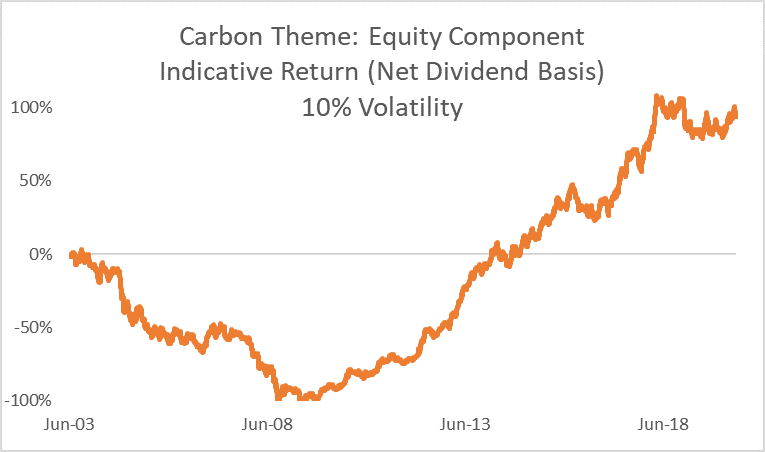
The chart below shows the summary return stream from this long/short equity exposure:

Returns from the equity market versus high carbon assets; see text for details; Source: Bloomberg

The chart identifies two very distinct periods for the exposure:

  • Through the commodity super-cycle, the strategy was disastrous: the strength of China’s demand for commodities caused the market to judge that income streams from carbon-producing sectors were increasingly valuable, the opposite of what the strategy seeks to gain exposure to;
  • By the start of the 2010s, however, the cycle turned and, as China’s dash for commodity-intensive growth abated, so did the relative weight of carbon-producing sectors in global equity markets;
  • The result was a return history for the strategy of large extremes.

To identify potential candidates for expressing the same theme in FX, we adopted a metric based on CO2 emissions relative to per capita GDP. The chart below shows, for selected countries, that the relative country rankings are stable even though the overall level of emissions per unit of GDP have trended lower.

Carbon emissions per capita / GDP per capita; ranked versus UK 2010; see text for details; Source: OECD

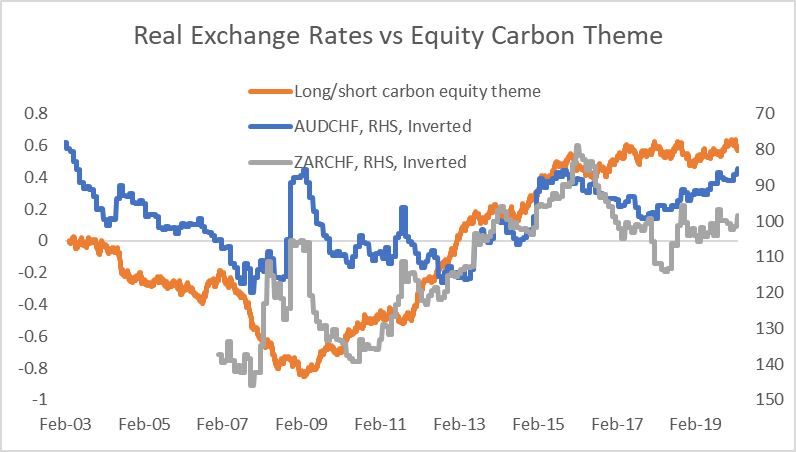
Taking the extremes from this group of countries to allow a long/short portfolio to be structured, we first consider the relationship between the relative price of carbon as measured by equity market returns and FX.

CPI-based real exchange rates (Jan 2014 = 100) versus carbon equity theme returns; Source: Bloomberg

The chart shows that there is a long run relationship between the real exchange rates of the chosen pairs and the equity theme. Indeed, this is a well known channel in FX analysis: given that both Australia and South Africa are commodity exporters, while Switzerland is a commodity importer, we would expect that the equity returns embedded in the carbon equity theme would act as a proxy for the terms of trade in commodities.

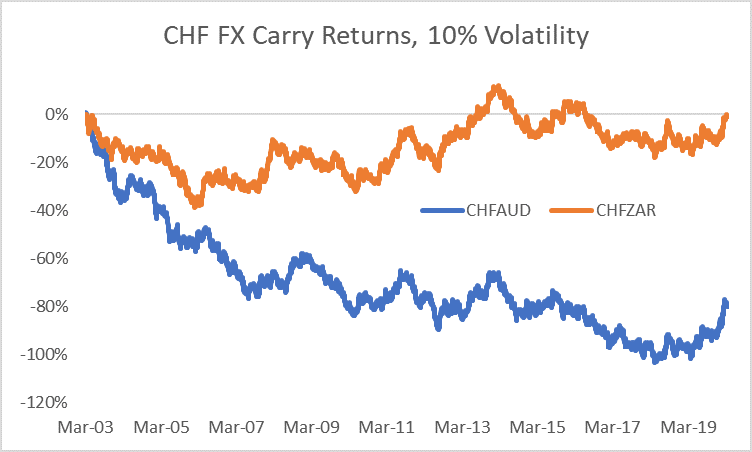
Regrettably, this is not sufficient for the construction of a profitable FX strategy, however. As shown in the chart below, the persistently higher level of interest rates in Australia and South Africa compared with Switzerland either neutralise or dominate the prospective long run return stream coming from the relative pricing of carbon.

FX carry return for strategies long CHF versus short AUD and ZAR, respectively; Source: Bloomberg

We adopt two approaches in seeking to address these problems:

  • We use more recent and detailed metrics for assessing countries’ carbon exposure; and
  • We actively seek to control for non-carbon risks using a portfolio of both developed (DM) and emerging market (EM) currencies.

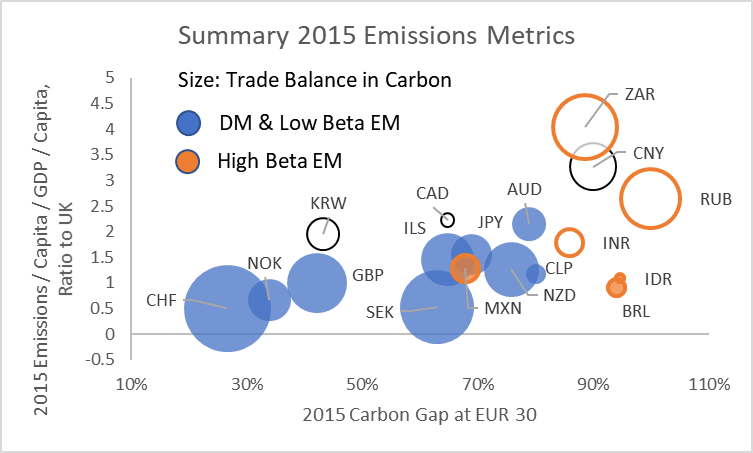
The chart below summarises a number of metrics compiled by the OECD on carbon emissions.

CO2 emissions on various OECD metrics – see text for details; Source: OECD

The chart displays the following:

  • The x-axis shows the OECD’s measure of the carbon gap: a way of measuring the proportion of economic activity within a country that reflects carbon prices at or above certain levels judged to be consistent with long run climate pledges – the lower the gap, the more competitive is economic activity in a country assuming that carbon prices adjust to the level required to contain global warming;
  • The y-axis shows emissions per capita, with all countries shown as a ratio to the UK purely for the purpose of easy visual comparison;
  • The size of the bubbles shows the OECD’s estimate of whether a country is a carbon exporter (bubbles with a white centre) or importer (coloured) as embedded in the goods it trades – the size of the bubble shows the size of the country’s exposure to net trade;
  • Finally, we distinguish high beta EM currencies from other currencies because they typically suffer both weaker currencies and higher interest rates in a period of risk aversion, thereby creating a higher volatility return structure.

How might we consider these metrics in forming a carbon FX portfolio?

  • First, early adjustment to higher carbon prices should, in principle, be a source of competitive advantage, with those countries standing to benefit as policies in other countries converge over time;
  • Second, large net exporters of carbon embedded in goods trade are prospectively particularly exposed to changes in other countries’ policies regarding carbon pricing, eg through carbon border taxes;
  • Third, any meaningful FX portfolio exposure to carbon needs to consider how to manage EM risk.

In addition to these considerations, the approach we take seeks to adjust to the natural grains of the FX market:

  • We select currencies such that the portfolio has no net dollar exposure given the dominance of the dollar factor in pricing currency risk independent of carbon exposure;
  • We seek to limit exposure to managed currencies and in particular elect not to include China in the portfolios because of the amplified effect its currency moves can have on other EM currencies;
  • We seek to balance out risk exposure between currency pairs with otherwise similar risk exposures, eg to safe haven flows, carry, cyclical risk or EM beta risk;
  • Nonetheless, investors should bear in mind that EM assets naturally reflect a higher level of idiosyncratic risk than DM and that this may periodically overwhelm the desired carbon exposure.

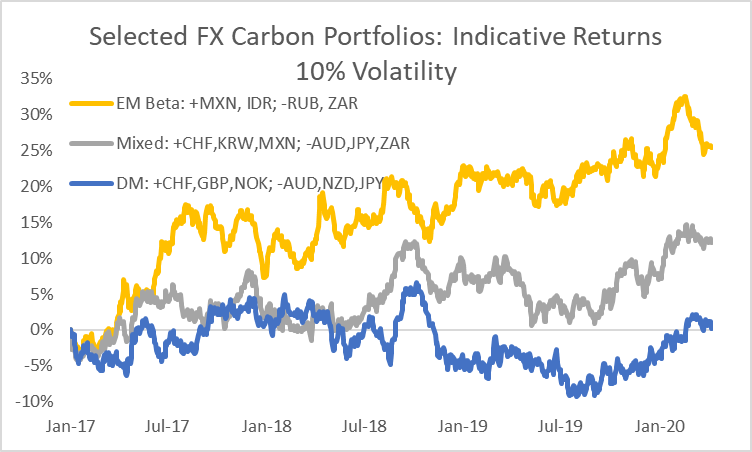
The chart below summarises the performance of three different portfolios. The portfolios are based on slow-moving information that is published with a long lag, hence returns should be treated as purely indicative, with the merit of the inputs in selecting currency exposure better gauged over the coming economic cycle. Some investors may seek to implement an active management overlay to allow, for example, within-bucket risk reallocation based on other valuation metrics whilst retaining the same directional exposure to carbon.

FX long/short carbon portfolios – see text for details on construction; Source: Bloomberg

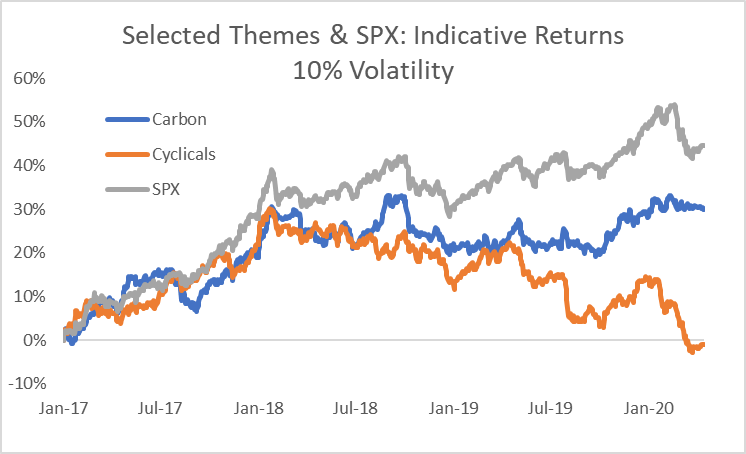
Finally, we combine the mixed FX portfolio with the equities carbon theme shown above to demonstrate the concept of a cross-asset carbon theme, comparing the resulting return streams in comparison with our cyclicals theme and the S&P 500, all at 10% volatility.

Returns to selected themes and the S&P 500 at 10% volatility – see text for construction; Source: Bloomberg